
Ellora Caves: A Timeless Masterpiece of Indian Rock-Cut Architecture
Nestled in the rugged Sahyadri Hills near Aurangabad, Maharashtra, the Ellora Caves stand as a monumental tribute to India’s ancient spiritual and artistic heritage. Carved meticulously between the 6th and 10th centuries CE, Ellora is more than just a collection of caves — it is a breathtaking confluence of three major religions: Hinduism, Buddhism, and Jainism, all coexisting in harmony within a single site.
Declared a UNESCO World Heritage Site in 1983, the Ellora Caves are an unmatched testament to religious tolerance, technical skill, and artistic brilliance that flourished in ancient India.
A Glimpse Into History
The Ellora Caves comprise 34 rock-cut caves, extending over 2 kilometers along a basalt cliff. These are divided into three distinct sections:
- 12 Buddhist caves (Caves 1–12) – carved between 600 and 800 CE
- 17 Hindu caves (Caves 13–29) – created between 600 and 900 CE
- 5 Jain caves (Caves 30–34) – developed around 800 to 1000 CE
This multi-religious site reflects the inclusive spirit of ancient Indian rulers, particularly those from the Rashtrakuta dynasty, who supported multiple faiths and patronized grand architectural works.
Architectural Marvels of Each Faith
1. The Buddhist Caves
The Buddhist caves at Ellora are the earliest group, showcasing the Hinayana and Mahayana sects of Buddhism. These caves primarily served as monasteries (viharas) and prayer halls (chaityas).
- Cave 5 (Maharwada Cave) is the largest vihara, with a grand central hall and long benches, believed to be a dining or assembly area.
- Cave 10 (Vishvakarma Cave) is the most famous Buddhist cave, also called the “Carpenter’s Cave” due to its intricately carved wooden-beam-like ceiling. It houses a towering seated Buddha in a chaitya hall, surrounded by the echo of ancient chants.
These caves exemplify the serenity, simplicity, and meditative qualities of Buddhist architecture, with images of the Buddha, Bodhisattvas, and carved stupas.
2. The Hindu Caves
The Hindu caves are the most dramatic in scale and symbolism. They mark a transition from simple monastic spaces to elaborate temples filled with divine narratives, cosmic symbolism, and larger-than-life sculptures.
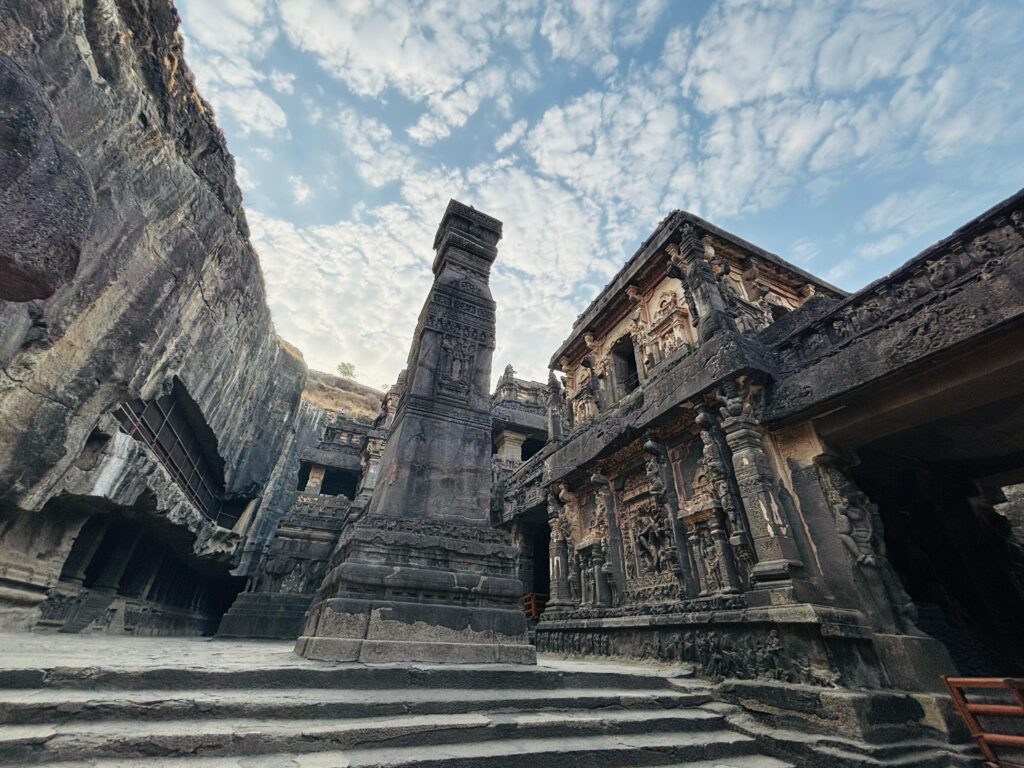
- Cave 16 – The Kailasa Temple is the crown jewel of Ellora and a global marvel of rock-cut architecture. Carved from a single monolithic rock, this temple is dedicated to Lord Shiva and designed to resemble Mount Kailash, his mythical abode.
- It measures 276 feet long, 154 feet wide, and 96 feet high.
- It was carved top-down, a unique technique that removed over 200,000 tons of rock.
- The temple complex includes courtyards, pillared halls, shrines, and towering sculptures of Shiva, Parvati, Nandi (Shiva’s bull), elephants, and scenes from epics like the Ramayana and Mahabharata.
Other Hindu caves such as Cave 14 (Ravana Ka Khai) and Cave 21 (Rameshvara) also showcase detailed carvings of various deities, mythical beings, and ornate pillars, celebrating both mythology and mastery in stonework.
3. The Jain Caves
Located at the northern end of the site, the Jain caves are smaller in number but equally impressive. Reflecting the austerity and philosophical nature of Jainism, these caves focus on fine details, symmetrical designs, and sacred symbolism.
- Cave 32 (Indra Sabha) is the most elaborate Jain cave, with two stories of halls and sanctums, adorned with sculptures of Tirthankaras, celestial beings, and lotus medallions on the ceiling.
- The Jain caves emphasize balance and grace, combining spiritual symbolism with artistic elegance.
These caves also offer stunning carvings of Lord Mahavira, Parshvanatha, and yakshas and yakshinis (guardian deities).
Spiritual Unity in Stone
One of the most remarkable aspects of Ellora is its inter-religious harmony. At a time when religious identities often led to divisions, Ellora stood as a beacon of coexistence and respect. Here, within a span of a few hundred meters, monks of three religions meditated, worshipped, and created masterpieces side by side.
This peaceful cohabitation underscores India’s ancient tradition of tolerance, inclusion, and pluralism — values still cherished today.
Inspiration and Symbolism
The architectural layout and iconography of Ellora are more than ornamental — they are deeply symbolic.
- The Kailasa Temple, for instance, is a symbolic universe, where each chamber represents a cosmic concept.
- Sculptures narrate stories from the Ramayana, Mahabharata, and Puranas, guiding devotees from the material world to spiritual enlightenment.
- The placement of shrines, the direction of carvings, and the rhythm of light and space within the caves are aligned with ancient Vastu and cosmic principles.
Each carving is a visual scripture — filled with meaning, movement, and myth.
Artistic and Engineering Feat
What makes Ellora even more astonishing is the engineering brilliance of its creators. They worked with limited tools — mainly chisels, hammers, and sheer human determination — yet produced structures that rival even modern architecture in precision and grandeur.
Creating the Kailasa Temple alone likely took multiple generations of artisans and decades of labor. The fact that this temple was carved from a single rock without modern machinery is a testament to ancient India’s technical ingenuity.
Ellora Today: A Living Legacy
Today, Ellora continues to inspire awe among historians, artists, architects, and travelers from around the globe. The caves are well-preserved under the Archaeological Survey of India and attract thousands of visitors every year.
Modern amenities such as guides, audio tours, and informative plaques make the site accessible, while its tranquil surroundings allow for a reflective experience. Whether you are a pilgrim, history enthusiast, or casual tourist, Ellora offers something deeply moving.
Nearby attractions include: ellora caves
- Ajanta Caves (a Buddhist site with stunning murals)ellora caves
- Daulatabad Fort
- Grishneshwar Temple (one of the 12 Jyotirlingas)ellora caves
- Aurangabad city with its unique Mughal architectureellora caves
Best Time to Visit
- October to March is the best season, with cooler temperatures and clear skies.
- The Ellora Ajanta Festival, held in February or March, brings classical music, dance, and culture to the backdrop of these ancient caves — a treat for both eyes and soul.ellora caves
Travel Tips
- Wear comfortable walking shoes — the caves are spread out and involve steps.ellora caves
- Carry water and sun protection, especially in summer.
- Hire a local guide or audio tour for deeper insights into the carvings and symbolism.ellora caves
- Photography is allowed in most caves but use flash cautiously.ellora caves
Conclusion: A Journey Through Time and Spirit
The Ellora Caves are not merely historic monuments — they are an open book of India’s spiritual wisdom, artistic genius, and cultural unity. In their silent stone walls, you can hear the echoes of prayers, the chisel’s rhythm, and the heartbeat of a civilization that believed in something greater than itself.
Visiting Ellora is like walking through a museum without glass — where gods dance, stories come alive, and faith is immortalized in stone. It’s a journey every traveler must undertake at least once in their lifetime — not just to witness the past, but to feel its soul.