
Somnath Temple: The Eternal Shrine of Lord Shiva by the Arabian Sea
On the shores of the Arabian Sea, in the western Indian state of Gujarat, stands the majestic Somnath Temple — a symbol of faith, resilience, and architectural beauty. Revered as the first among the twelve Jyotirlingas, Somnath is not only a key pilgrimage destination for Hindus but also a powerful testament to India’s ability to rebuild and thrive despite invasions and destruction.
Somnath, which translates to “Lord of the Moon,” is associated with Lord Shiva and has been a center of spiritual energy and devotion for millennia. The temple’s divine presence, fascinating history, and scenic coastal surroundings make it a destination that touches the soul and captivates the heart.
Mythological Origins: Somnath and the Moon God
According to Hindu mythology, Chandra Dev (Moon God) was once cursed by his father-in-law, Daksha Prajapati, to lose his radiance. Chandra, seeking redemption, worshipped Lord Shiva at the site where Somnath now stands. Pleased with his devotion, Shiva relieved Chandra of the curse and restored his brightness.
To honor Lord Shiva, Chandra is said to have built a golden temple, which was later rebuilt in silver by Ravana, in wood by Krishna, and finally in stone by King Bhimdev of the Solanki dynasty. This mythological lineage is why Somnath is revered as the first Jyotirlinga — where Shiva manifested in a luminous column of light.
Architectural Grandeur: A Temple That Rises Again and Again
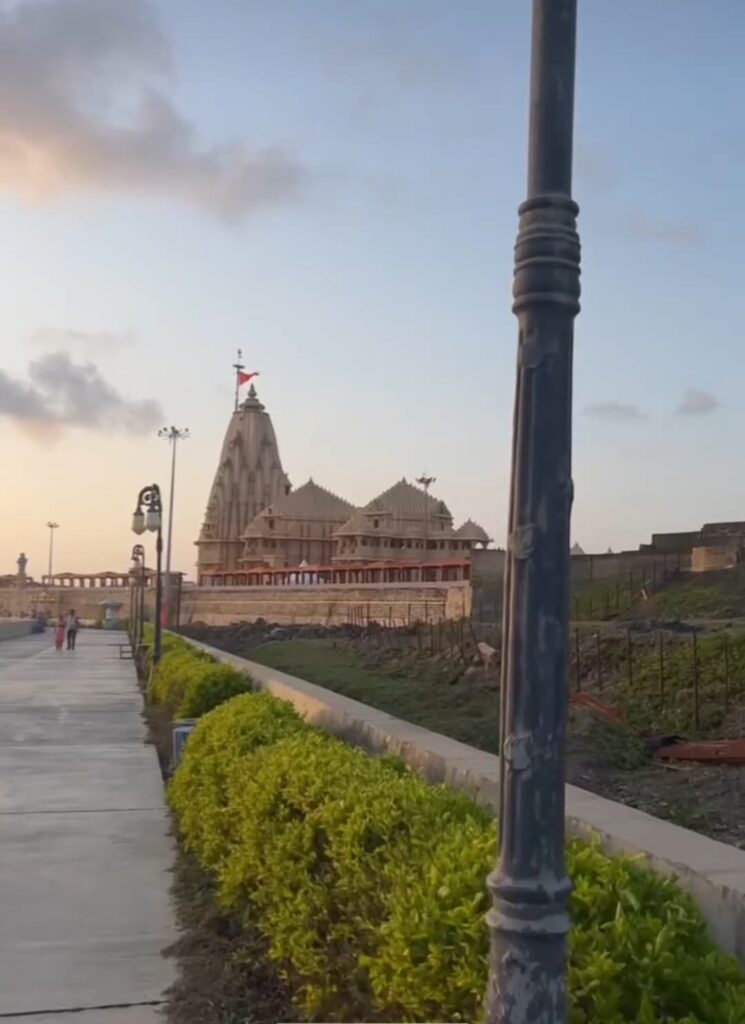
The present-day Somnath Temple, constructed in Chalukya style architecture, is a testament to resilience and craftsmanship. With intricate carvings, majestic shikharas (spires), and a striking backdrop of the ocean, the temple exudes both divinity and elegance.
- The temple’s main spire (shikhara) is 50 meters high.
- A flag measuring 37 feet long flutters atop the shikhara — changed three times a day.
- An arrow engraved on the temple wall points directly toward the South Pole, symbolizing that there’s no land between Somnath and Antarctica in a straight line — a testament to India’s ancient astronomical knowledge.
The temple complex is beautifully maintained, with well-paved paths, spiritual music, and peaceful courtyards, creating an atmosphere of tranquility and reverence.
A History of Destruction and Resurrection
Somnath’s history is as awe-inspiring as its architecture. The temple has been destroyed and rebuilt several times, and each time, it has risen stronger, a symbol of India’s undying spirit.
Key historical events:
- 1025 AD: Mahmud of Ghazni plundered and destroyed the temple, taking away immense wealth.
- 1299 AD: Allauddin Khilji’s forces desecrated the shrine again.
- 1665 AD: Aurangzeb ordered the temple to be demolished.
- Each time, local rulers and devotees rebuilt it, determined to preserve its spiritual significance.
The final and current reconstruction took place after India’s independence, led by Sardar Vallabhbhai Patel and K.M. Munshi, as a mark of national and religious pride. The temple was inaugurated in 1951 and has since become a beacon of cultural revival and national identity.
Spiritual Significance: The First Jyotirlinga
The twelve Jyotirlingas are considered the most sacred abodes of Lord Shiva, and Somnath is said to be the first and foremost among them. It is believed that worshipping here offers moksha (liberation) and removes all past sins.
The inner sanctum of the temple houses the Shiva Linga, constantly bathed in sacred water, milk, and offerings from thousands of devotees. The spiritual energy in the Garbhagriha (inner sanctum) is palpable, especially during arti (ritual prayer), which is performed three times a day — at 7:00 AM, 12:00 noon, and 7:00 PM.
Must-Visit Spots Around the Somnath Temple
1. Triveni Sangam
Just a short walk from the temple is the confluence of three rivers — Hiran, Kapila, and Saraswati — known as Triveni Sangam. It’s a sacred bathing spot where pilgrims perform rituals for departed souls. A dip here is believed to cleanse one’s karma.
2. Bhalka Tirth
Located around 5 km from the main temple, Bhalka Tirth is the site where Lord Krishna was accidentally shot in the foot by a hunter, marking the end of his earthly avatar. A serene temple has been built at the location, drawing both devotees and spiritual seekers.
3. Gita Mandir
Built by the Birla family, this temple is dedicated to Lord Krishna and contains beautiful marble inscriptions of the Bhagavad Gita. The architecture is modern yet spiritually uplifting.
4. Prabhas Patan Museum
For history enthusiasts, the Somnath Museum houses relics and artifacts recovered from earlier versions of the temple — including sculptures, inscriptions, and temple fragments that offer a glimpse into its rich past.
Festivals and Celebrations
Somnath is particularly vibrant during festivals. If you visit during any of these, you’ll experience the town at its spiritual peak:
- Mahashivratri: Thousands gather for night-long prayers, chanting, and rituals in honor of Lord Shiva.
- Shravan Month (July–August): A sacred month for Shiva worship, with special daily offerings and events.
- Kartik Purnima: Celebrated with lighting of lamps, processions, and ocean-side rituals.
During these times, the temple is adorned with flowers, the air is filled with devotional music, and the spirit of unity and faith is powerful.
How to Reach Somnath
- By Air: The nearest airport is Diu Airport (65 km). Another option is Rajkot Airport (195 km).
- By Train: Veraval Railway Station is just 6 km from the temple and is well connected to major cities in Gujarat and Maharashtra.
- By Road: Buses and private taxis operate from Ahmedabad, Rajkot, Junagadh, and Diu.
Best Time to Visit
The best time to visit Somnath is from October to March, when the weather is cool and ideal for temple visits and coastal sightseeing.
- Summer (April–June): Can be hot but manageable.
- Monsoon (July–September): Lush greenery, though rainfall might hinder travel.
- Winter (October–February): Pleasant and festive.
Where to Stay
Somnath offers a variety of accommodations:
- Temple Trust Guesthouses for budget stays.
- Mid-range hotels and lodges in and around Somnath and Veraval.
- Luxury resorts by the beach for those seeking comfort with a view.
Travel Tips
- Dress modestly; traditional attire is preferred inside temple premises.
- Temple darshan lines may be long during festivals — plan early.
- Cameras and mobile phones are not allowed inside the temple.
- Combine your trip with Dwarka, Gir National Park, or Diu for a broader travel experience.
Conclusion: A Shrine of Devotion and National Pride
Somnath Temple is more than just a place of worship — it is a symbol of India’s cultural soul, unwavering faith, and spiritual endurance. Standing by the roaring sea, it reminds every visitor of the power of belief — belief that cannot be broken by time, invaders, or nature.
As the sun sets behind the Arabian Sea and the temple bells echo through the air, you’ll feel a deep connection to something ancient, powerful, and eternal. Whether you’re a pilgrim seeking divine blessings, a history lover exploring centuries of resilience, or a traveler in search of meaning, Somnath offers a journey you’ll never forget.